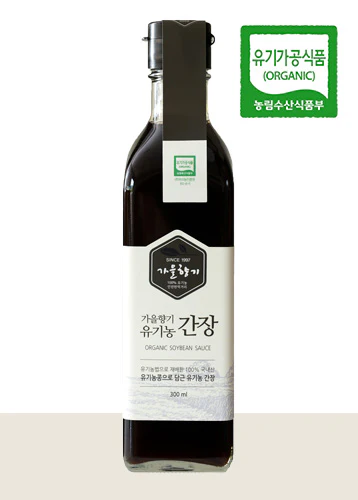
[Gaeul Hyanggi] Organic Traditional Soy Sauce

100% Organic Soy Sauce
[Gaeul Hyanggi] Organic Traditional Soy Sauce
This is a traditional Korean soy sauce made the slow way—starting with organically grown Korean soybeans that are cooked, mashed, and shaped into meju (fermented soybean blocks), then left to ferment naturally with rice straw in a loess aging room. The blocks are brined with mineral-rich, sun-dried sea salt and transferred to traditional Korean earthenware jars (onggi), where they age outdoors under sun and air, sometimes for months, developing depth and nuance.
It is fully organic-certified.
In 2004, Gaeul Hyanggi Farm became the first producer in Korea to receive organic certification in the traditional jang (fermented sauce) category—a meaningful distinction in a sector long dominated by conventional production.
Unlike mass-produced soy sauces that are heat-treated for shelf stability, this one is left raw. That decision matters.
Without pasteurization, the sauce retains aromatic compounds and layered savory notes that can flatten under high heat processing.
The result is a soy sauce that’s assertively salty but clean, with a restrained sweetness and a deep, anchovy-like umami that lingers rather than spikes.
In the Korean pantry, this style aligns most closely with guk-ganjang—a soup soy sauce.
Its slightly lighter color and higher salinity make it especially useful for seasoning broths, stews, and braises without muddying their appearance. A spoonful sharpens a soybean paste stew, seasons a pot of beef radish soup, or quietly intensifies braised vegetables. It also works as a finishing salt: a few drops in place of kosher salt can add both salinity and complexity.
Because it is not pasteurized, please store in refrigerator after opening (not at room temeprature).
Ingredient list? Water, traditional meju (soybeans), and sun-dried sea salt. No sweeteners, no wheat, no caramel color, no preservatives. Just time, microbes, clay jars, and air doing the work.
Available in 300ml or 500ml glass container.
What Type of Soy Sauce Is This?
This is Traditional Joseon Soy Sauce (조선간장), also known as Guk-ganjang (국간장), or “soup soy sauce.”
This traditional soy sauce is ideal for seasoning broths, soups, and jjigae, where its clean salinity and lighter color add depth without darkening the dish.
Beyond broths and soups, it is also commonly used to season Korean vegetable side dishes (namul), such as spinach muchim (시금치무침) and soybean sprout muchim (콩나물무침).
This is in contrast to brewed soy sauce (Jin Ganjang, 진간장). Jin Ganjang is typically used in Korean cooking for stir-fries, braised dishes, and meat marinades.
100% Organic Soy Sauce
[Gaeul Hyanggi] Organic Traditional Soy Sauce
This is a traditional Korean soy sauce made the slow way—starting with organically grown Korean soybeans that are cooked, mashed, and shaped into meju (fermented soybean blocks), then left to ferment naturally with rice straw in a loess aging room. The blocks are brined with mineral-rich, sun-dried sea salt and transferred to traditional Korean earthenware jars (onggi), where they age outdoors under sun and air, sometimes for months, developing depth and nuance.
It is fully organic-certified.
In 2004, Gaeul Hyanggi Farm became the first producer in Korea to receive organic certification in the traditional jang (fermented sauce) category—a meaningful distinction in a sector long dominated by conventional production.
Unlike mass-produced soy sauces that are heat-treated for shelf stability, this one is left raw. That decision matters.
Without pasteurization, the sauce retains aromatic compounds and layered savory notes that can flatten under high heat processing.
The result is a soy sauce that’s assertively salty but clean, with a restrained sweetness and a deep, anchovy-like umami that lingers rather than spikes.
In the Korean pantry, this style aligns most closely with guk-ganjang—a soup soy sauce.
Its slightly lighter color and higher salinity make it especially useful for seasoning broths, stews, and braises without muddying their appearance. A spoonful sharpens a soybean paste stew, seasons a pot of beef radish soup, or quietly intensifies braised vegetables. It also works as a finishing salt: a few drops in place of kosher salt can add both salinity and complexity.
Because it is not pasteurized, please store in refrigerator after opening (not at room temeprature).
Ingredient list? Water, traditional meju (soybeans), and sun-dried sea salt. No sweeteners, no wheat, no caramel color, no preservatives. Just time, microbes, clay jars, and air doing the work.
Available in 300ml or 500ml glass container.
What Type of Soy Sauce Is This?
This is Traditional Joseon Soy Sauce (조선간장), also known as Guk-ganjang (국간장), or “soup soy sauce.”
This traditional soy sauce is ideal for seasoning broths, soups, and jjigae, where its clean salinity and lighter color add depth without darkening the dish.
Beyond broths and soups, it is also commonly used to season Korean vegetable side dishes (namul), such as spinach muchim (시금치무침) and soybean sprout muchim (콩나물무침).
This is in contrast to brewed soy sauce (Jin Ganjang, 진간장). Jin Ganjang is typically used in Korean cooking for stir-fries, braised dishes, and meat marinades.
Original: $44.99
-70%$44.99
$13.50Description
100% Organic Soy Sauce
[Gaeul Hyanggi] Organic Traditional Soy Sauce
This is a traditional Korean soy sauce made the slow way—starting with organically grown Korean soybeans that are cooked, mashed, and shaped into meju (fermented soybean blocks), then left to ferment naturally with rice straw in a loess aging room. The blocks are brined with mineral-rich, sun-dried sea salt and transferred to traditional Korean earthenware jars (onggi), where they age outdoors under sun and air, sometimes for months, developing depth and nuance.
It is fully organic-certified.
In 2004, Gaeul Hyanggi Farm became the first producer in Korea to receive organic certification in the traditional jang (fermented sauce) category—a meaningful distinction in a sector long dominated by conventional production.
Unlike mass-produced soy sauces that are heat-treated for shelf stability, this one is left raw. That decision matters.
Without pasteurization, the sauce retains aromatic compounds and layered savory notes that can flatten under high heat processing.
The result is a soy sauce that’s assertively salty but clean, with a restrained sweetness and a deep, anchovy-like umami that lingers rather than spikes.
In the Korean pantry, this style aligns most closely with guk-ganjang—a soup soy sauce.
Its slightly lighter color and higher salinity make it especially useful for seasoning broths, stews, and braises without muddying their appearance. A spoonful sharpens a soybean paste stew, seasons a pot of beef radish soup, or quietly intensifies braised vegetables. It also works as a finishing salt: a few drops in place of kosher salt can add both salinity and complexity.
Because it is not pasteurized, please store in refrigerator after opening (not at room temeprature).
Ingredient list? Water, traditional meju (soybeans), and sun-dried sea salt. No sweeteners, no wheat, no caramel color, no preservatives. Just time, microbes, clay jars, and air doing the work.
Available in 300ml or 500ml glass container.
What Type of Soy Sauce Is This?
This is Traditional Joseon Soy Sauce (조선간장), also known as Guk-ganjang (국간장), or “soup soy sauce.”
This traditional soy sauce is ideal for seasoning broths, soups, and jjigae, where its clean salinity and lighter color add depth without darkening the dish.
Beyond broths and soups, it is also commonly used to season Korean vegetable side dishes (namul), such as spinach muchim (시금치무침) and soybean sprout muchim (콩나물무침).
This is in contrast to brewed soy sauce (Jin Ganjang, 진간장). Jin Ganjang is typically used in Korean cooking for stir-fries, braised dishes, and meat marinades.