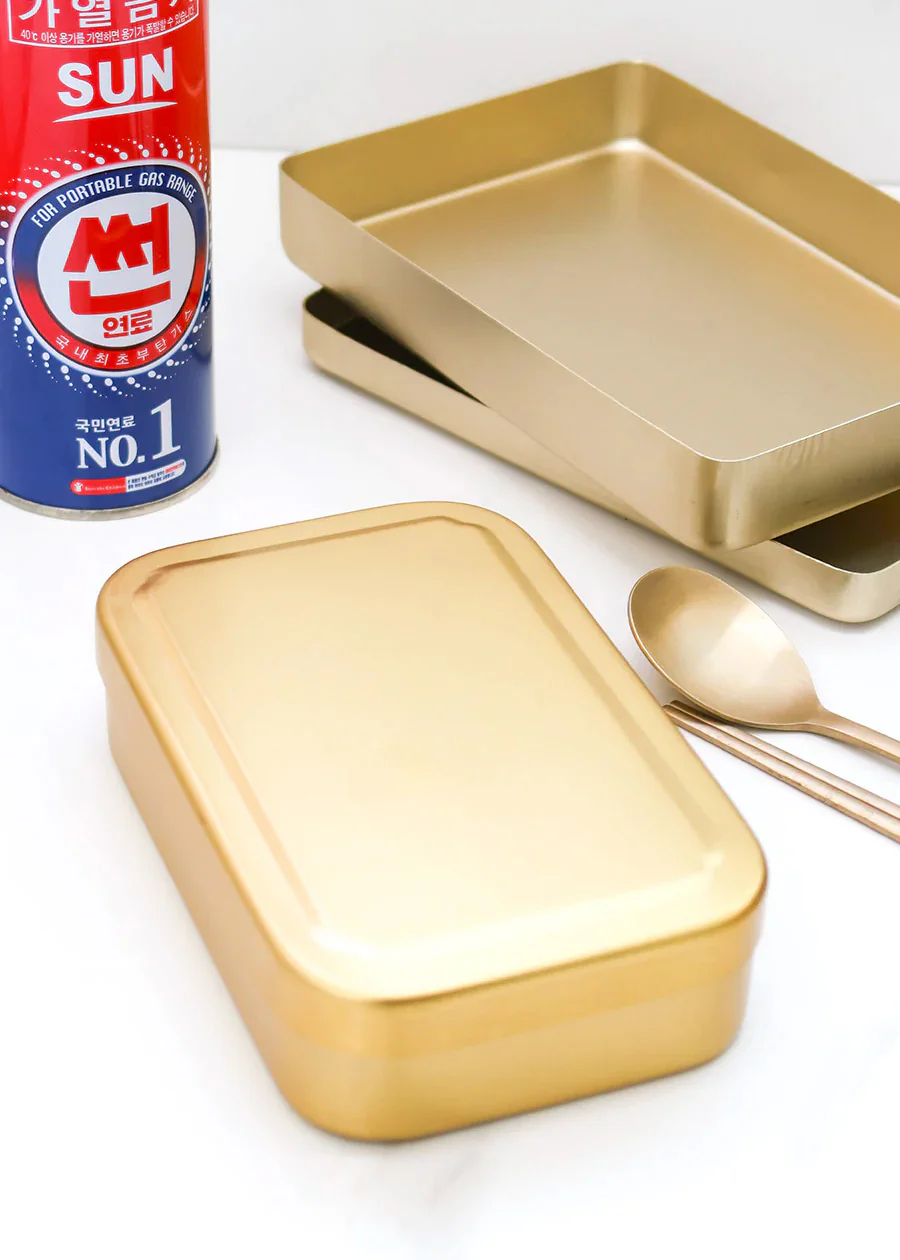
Korean Traditional Dosirak - Aluminum Lunchbox (3 Sizes)

Pre-1980s, Old School Korean Dosirak
Korean Traditional Dosirak - Aluminum Lunchbox (3 Varieties)
Today, we offer Traditional Korean Dosirak Lunchboxes.
In the 1970s - when Korea was starting its industrialization - aluminum was used to mass-produce kitchenware like pots and lunchbox containers.
(These aluminum pots are called yangeun-nembi in Korean “양은 냄비”.)
Students would place their aluminum lunchboxes on the classroom radiator - to keep it hot and steamy until lunchtime.
These golden, aluminum lunch boxes symbolize childhood for many Koreans.
For rich students, their lunchbox included a scoop of white rice, stir-fried kimchi, processed meat (like SPAM) and/or banchan like stir-fried anchovies (myeolchi bokkeum).
For many, their dosiraks were primarily barley rice (보리밥), leftover banchan and maybe... a fried egg.
Dosirak was a point for comparison (and bullying) for children during these times.
These traditional dosirak lunchboxes are still around in Korea. In fact, you’ll see them at Korean BBQ restaurants to serve old-school dosirak (옛날 도시락).
Today, we offer 3 sizes of these traditional dosirak containers:
- 1. Oval Dosirak (1호): 17 x 11 x 4 cm
- 2. Flat Rectangle Dosirak (2호): 20.5 x 14.5 x 3.5 cm
- 3. Rectangle Dosirak (3호): 20.5 x 14.5 x 4 cm
(#2 and #3 are the same in width and length, but vary slightly in height)
How's it made?
The pots are made of “anodized” aluminum - the aluminum first undergoes a high electrical wash to oxidize the surface and to produce a rust-resistant surface. Then, it's undergoes a 95C (200F) pressurized steam cycle to finish the protective coating.
If you like the look of these old-school Korean Dosirak containers, use them from time-to-time to keep history alive!
Usage note: these containers conduct heat very well. After scooping-in hot rice or banchans, they will get hot almost immediately (so be conscience of this while handling it).
Pre-1980s, Old School Korean Dosirak
Korean Traditional Dosirak - Aluminum Lunchbox (3 Varieties)
Today, we offer Traditional Korean Dosirak Lunchboxes.
In the 1970s - when Korea was starting its industrialization - aluminum was used to mass-produce kitchenware like pots and lunchbox containers.
(These aluminum pots are called yangeun-nembi in Korean “양은 냄비”.)
Students would place their aluminum lunchboxes on the classroom radiator - to keep it hot and steamy until lunchtime.
These golden, aluminum lunch boxes symbolize childhood for many Koreans.
For rich students, their lunchbox included a scoop of white rice, stir-fried kimchi, processed meat (like SPAM) and/or banchan like stir-fried anchovies (myeolchi bokkeum).
For many, their dosiraks were primarily barley rice (보리밥), leftover banchan and maybe... a fried egg.
Dosirak was a point for comparison (and bullying) for children during these times.
These traditional dosirak lunchboxes are still around in Korea. In fact, you’ll see them at Korean BBQ restaurants to serve old-school dosirak (옛날 도시락).
Today, we offer 3 sizes of these traditional dosirak containers:
- 1. Oval Dosirak (1호): 17 x 11 x 4 cm
- 2. Flat Rectangle Dosirak (2호): 20.5 x 14.5 x 3.5 cm
- 3. Rectangle Dosirak (3호): 20.5 x 14.5 x 4 cm
(#2 and #3 are the same in width and length, but vary slightly in height)
How's it made?
The pots are made of “anodized” aluminum - the aluminum first undergoes a high electrical wash to oxidize the surface and to produce a rust-resistant surface. Then, it's undergoes a 95C (200F) pressurized steam cycle to finish the protective coating.
If you like the look of these old-school Korean Dosirak containers, use them from time-to-time to keep history alive!
Usage note: these containers conduct heat very well. After scooping-in hot rice or banchans, they will get hot almost immediately (so be conscience of this while handling it).
Original: $27.99
-70%$27.99
$8.40Description
Pre-1980s, Old School Korean Dosirak
Korean Traditional Dosirak - Aluminum Lunchbox (3 Varieties)
Today, we offer Traditional Korean Dosirak Lunchboxes.
In the 1970s - when Korea was starting its industrialization - aluminum was used to mass-produce kitchenware like pots and lunchbox containers.
(These aluminum pots are called yangeun-nembi in Korean “양은 냄비”.)
Students would place their aluminum lunchboxes on the classroom radiator - to keep it hot and steamy until lunchtime.
These golden, aluminum lunch boxes symbolize childhood for many Koreans.
For rich students, their lunchbox included a scoop of white rice, stir-fried kimchi, processed meat (like SPAM) and/or banchan like stir-fried anchovies (myeolchi bokkeum).
For many, their dosiraks were primarily barley rice (보리밥), leftover banchan and maybe... a fried egg.
Dosirak was a point for comparison (and bullying) for children during these times.
These traditional dosirak lunchboxes are still around in Korea. In fact, you’ll see them at Korean BBQ restaurants to serve old-school dosirak (옛날 도시락).
Today, we offer 3 sizes of these traditional dosirak containers:
- 1. Oval Dosirak (1호): 17 x 11 x 4 cm
- 2. Flat Rectangle Dosirak (2호): 20.5 x 14.5 x 3.5 cm
- 3. Rectangle Dosirak (3호): 20.5 x 14.5 x 4 cm
(#2 and #3 are the same in width and length, but vary slightly in height)
How's it made?
The pots are made of “anodized” aluminum - the aluminum first undergoes a high electrical wash to oxidize the surface and to produce a rust-resistant surface. Then, it's undergoes a 95C (200F) pressurized steam cycle to finish the protective coating.
If you like the look of these old-school Korean Dosirak containers, use them from time-to-time to keep history alive!
Usage note: these containers conduct heat very well. After scooping-in hot rice or banchans, they will get hot almost immediately (so be conscience of this while handling it).