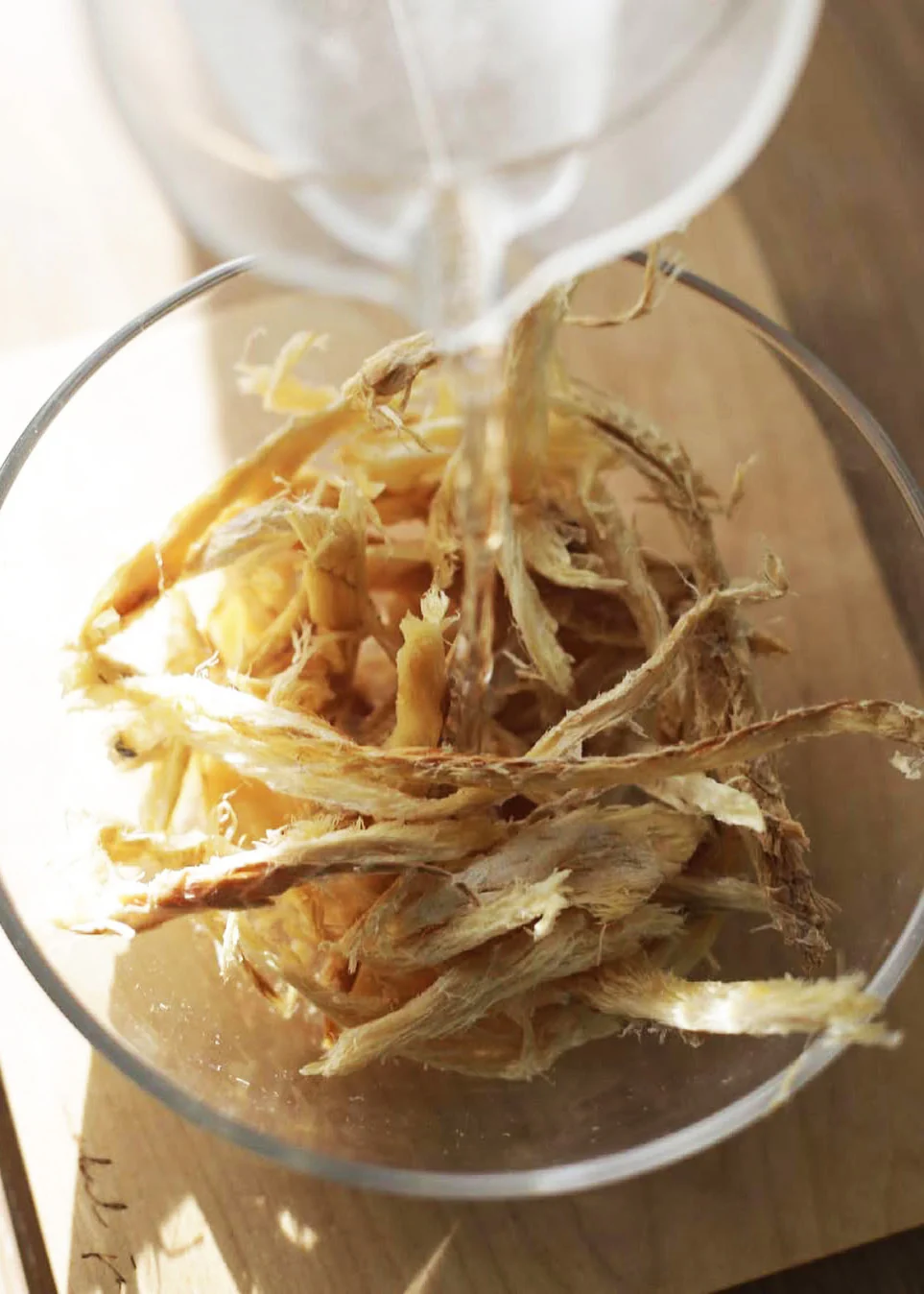
[Badaro] Korean Hwangtae (Naturally Dried Yellow Pollock)

Premium-Quality, Southern-Coast
[Badaro] Korean Hwangtae (Naturally Dried Yellow Pollock)
Hwangtae isn’t just dried pollock—it’s pollock transformed by winter. And Badaro’s hwangtae is made using the very process that defines the category at its best.
The fish itself is pollock harvested in Russian waters, then shipped frozen to Korea.
(Note: Almost all pollock consumed in Korea is imported frozen from Russia. Domestic pollock fishing was banned in 2019 to protect depleted stocks.)
From there, it’s brought to Yongdaeri, Inje—a high-altitude village long regarded as the gold standard for hwangtae production. This is where Badaro’s process begins.
Throughout the winter months, the pollock is hung outdoors on traditional drying racks, exposed to dozens of natural freeze–thaw cycles—freezing overnight, slowly thawing during the day.
This slow, weather-dependent process is what gives Badaro’s hwangtae its deep golden color, tender yet structured fibers, and clean, layered umami—qualities that shortcut methods simply can’t reproduce.
After drying, the pollock is aged in darkness, then carefully tenderized, skinned, and deboned following traditional methods. Each step is done with restraint, preserving the integrity of the flesh rather than forcing it.
The result is hwangtae that’s dry but pliable (never brittle), with a lightly nutty aroma and a flavor that deepens—not overwhelms—once soaked and cooked. It’s also meticulously cleaned, leaving virtually no bones, making it easy and safe to cook with.
Perfect for classic Korean hwangtae-guk (dried pollock soup), added to miyeok-guk (Korean seaweed soup), or lightly toasted in a pan and enjoyed as a simple anju.
Available in 150g.
Premium-Quality, Southern-Coast
[Badaro] Korean Hwangtae (Naturally Dried Yellow Pollock)
Hwangtae isn’t just dried pollock—it’s pollock transformed by winter. And Badaro’s hwangtae is made using the very process that defines the category at its best.
The fish itself is pollock harvested in Russian waters, then shipped frozen to Korea.
(Note: Almost all pollock consumed in Korea is imported frozen from Russia. Domestic pollock fishing was banned in 2019 to protect depleted stocks.)
From there, it’s brought to Yongdaeri, Inje—a high-altitude village long regarded as the gold standard for hwangtae production. This is where Badaro’s process begins.
Throughout the winter months, the pollock is hung outdoors on traditional drying racks, exposed to dozens of natural freeze–thaw cycles—freezing overnight, slowly thawing during the day.
This slow, weather-dependent process is what gives Badaro’s hwangtae its deep golden color, tender yet structured fibers, and clean, layered umami—qualities that shortcut methods simply can’t reproduce.
After drying, the pollock is aged in darkness, then carefully tenderized, skinned, and deboned following traditional methods. Each step is done with restraint, preserving the integrity of the flesh rather than forcing it.
The result is hwangtae that’s dry but pliable (never brittle), with a lightly nutty aroma and a flavor that deepens—not overwhelms—once soaked and cooked. It’s also meticulously cleaned, leaving virtually no bones, making it easy and safe to cook with.
Perfect for classic Korean hwangtae-guk (dried pollock soup), added to miyeok-guk (Korean seaweed soup), or lightly toasted in a pan and enjoyed as a simple anju.
Available in 150g.
Original: $58.99
-70%$58.99
$17.70Description
Premium-Quality, Southern-Coast
[Badaro] Korean Hwangtae (Naturally Dried Yellow Pollock)
Hwangtae isn’t just dried pollock—it’s pollock transformed by winter. And Badaro’s hwangtae is made using the very process that defines the category at its best.
The fish itself is pollock harvested in Russian waters, then shipped frozen to Korea.
(Note: Almost all pollock consumed in Korea is imported frozen from Russia. Domestic pollock fishing was banned in 2019 to protect depleted stocks.)
From there, it’s brought to Yongdaeri, Inje—a high-altitude village long regarded as the gold standard for hwangtae production. This is where Badaro’s process begins.
Throughout the winter months, the pollock is hung outdoors on traditional drying racks, exposed to dozens of natural freeze–thaw cycles—freezing overnight, slowly thawing during the day.
This slow, weather-dependent process is what gives Badaro’s hwangtae its deep golden color, tender yet structured fibers, and clean, layered umami—qualities that shortcut methods simply can’t reproduce.
After drying, the pollock is aged in darkness, then carefully tenderized, skinned, and deboned following traditional methods. Each step is done with restraint, preserving the integrity of the flesh rather than forcing it.
The result is hwangtae that’s dry but pliable (never brittle), with a lightly nutty aroma and a flavor that deepens—not overwhelms—once soaked and cooked. It’s also meticulously cleaned, leaving virtually no bones, making it easy and safe to cook with.
Perfect for classic Korean hwangtae-guk (dried pollock soup), added to miyeok-guk (Korean seaweed soup), or lightly toasted in a pan and enjoyed as a simple anju.
Available in 150g.